The Elite Edge: ⏳ The Promotion Cycle: It’s Decided Earlier Than You Think
Doing The Research For You.

Deepali Vyas
September 14, 2026
Elite Edge | Vol 2 Week 37
Let's skip the warmup. If you've ever been blindsided by a promotion cycle, the surprise wasn't the decision. It was the timing. You showed up to the wrong meeting expecting the real one to still be coming.
Here's the truth: the room where your title changes isn't a decision room. It's a confirmation room. The actual decision already happened, weeks or months earlier, in a room you weren't in.
How the promotion cycle actually works
At most companies, especially mid-size and large ones, the cycle looks like this:
Now through October: Budgets and headcount for the next review cycle get finalized. Managers quietly start building their case for who they'll fight for.
October through November: Calibration happens between your manager and their leadership. You are not in this room. This is where the real decision gets made.
December through January (or your company's version of it): Ratings and promotion announcements land. By this point the outcome is locked. You're watching a rerun.
The window where your manager is actively building your case is happening right now, not in your review.
Why good performers get passed over
People do strong work all year and still lose the promotion. Not because the work was weak. Because:
Their manager didn't have the language or evidence to make the case in calibration.
Their impact never left their immediate team.
They assumed good work speaks for itself and never translated it into a story anyone else could repeat.
Promotions are not won in the room. They're won in the months of positioning before anyone walks into that room.
The harsh truth nobody puts in a LinkedIn post
Here it is: your manager is not thinking about your career as much as you are. Not because they're a bad manager. Because they have fifteen priorities, a boss of their own, and a calibration meeting to survive. If you're waiting to be "noticed," you're not in a meritocracy. You're in a queue, and nobody's checking it.
Hope is not a strategy. Silence is not humility, it's invisibility. "I'll let my work speak for itself" is the single most common thing I hear from people who got passed over, right before they ask me why it happened.
If that stings, good. Sting is useful. Let's fix it before the window closes.
The BRAC System: The Two Tools That Change Everything
I created the BRAC framework, and most people only use half of it. That's the gap. Not effort. Not talent. Half a system.
The BRAC File: Your Testimonial Archive
Everyone talks about a BRAC file, so let's start there. Your BRAC file is external evidence that your work matters to other people. Every email from a client saying you saved the deal. Every Slack message from a colleague saying you made the difference. Every performance note, every thank you, every moment someone put in writing that you showed up.
Think of it as your professional testimonials. Screenshot it. Forward it. Archive it. When review season comes and someone asks for examples, you open the file instead of scrambling to remember.
The BRAC Book: Your Quantifiable Impact Record
The BRAC Book is something I developed separately, and this is the piece almost everyone skips.
BRAC stands for: Biggest wins. Results with numbers. Accomplishments others witnessed. Contributions above your level.
This is not a folder of nice emails. This is a living document where you track your impact in hard, defensible, measurable terms. Revenue influenced. Costs reduced. Headcount led. Projects shipped. Timelines compressed. Problems solved with a dollar figure attached.
The BRAC file tells people what others think of you. The BRAC Book tells people what you actually delivered.
You need both. The file is your social proof. The Book is your business case. Walking into a promotion conversation with only one is like showing up to a job interview with half a resume.
Update the BRAC Book weekly, two to three entries, before you forget. Most people can't articulate their own impact at review time because they never tracked it in real time. After today, you won't have that excuse either.
BRAC Book template, ready to copy and use today 👇

The Now-to-December Promotion Sprint
You don't need twelve months. You need the next 12 to 16 weeks used on purpose instead of on autopilot.
Phase 1, September: Build the evidence base
Start your BRAC Book today. Not Monday. Today.
Ask yourself the uncomfortable question: if you got hit by a bus tomorrow, would anyone above your manager know what you actually did this year? If the honest answer is no, that's your priority list.
Identify the 2 to 3 people in the calibration room who don't know your work well enough yet. Close that gap now, not in November when it looks desperate.
Phase 2, early October: Make the ask explicit
Use this exact framing in your next 1:1: "I'm aiming for [specific title/level]. What's the gap between where I am and what that role needs?" Specific asks get specific answers. Vague asks get vague nothing.
Follow up in writing. A one-line email summarizing what you discussed turns a conversation into a record. Verbal alignment evaporates. Paper doesn't.
If your manager dodges the question or gets vague, that's data. Don't explain it away because it's uncomfortable to sit with.
Phase 3, late October through November: Increase your surface area
Take the one visible, slightly uncomfortable assignment nobody else wants. Calibration rooms remember names attached to visible wins, not names attached to quiet competence.
Post about your work publicly. Not bragging, documenting. One well-written LinkedIn post about a shipped project does two jobs at once: proof your manager can point to, and proof to the market you're not sitting still.
Stop being the best-kept secret on your team. That's not modesty. That's a ceiling you built yourself.
Phase 4, December: Protect the outcome
Calibration season gets political and budgets get tight. This is not the month to go quiet. It's the month to make sure your manager has everything they need to fight for you when the room gets competitive.
If the answer is "not this cycle," ask directly what needs to be true next time, and get a date, not a platitude.
One harsh truth to close on
Nobody will fight harder for your career than you will. Recruiters won't. Your manager might, if you make it easy for them, but running this campaign is still your job. The people who get promoted aren't always the most talented in the room. They're the ones who made themselves impossible to overlook.
Quick poll, be honest with yourself
Since we just spent this whole issue on invisible work getting invisible outcomes, let's make it concrete. Answer these honestly, back to back: (Click & Vote 👇)
If someone in your calibration meeting looked you up on LinkedIn right now, what would they find? |
When's the last time you posted something that actually showcased your work or impact? |
Have you ever thought about (or actually) blocked your boss on LinkedIn? |
Here's the commentary nobody asked for but everyone needs: blocking your boss doesn't protect you. It just makes your ambition invisible to the one person who could actually advocate for you in that calibration room we talked about earlier. If your instinct is to hide your visibility from your manager instead of showing it to them, that's not caution. That's a strategy built on the assumption that being seen is dangerous, when being seen is the entire point. If you're worried what it "looks like," the fix isn't to disappear, it's to post things you'd be comfortable having your boss see, because a strong, professional presence should be an asset to your case, not a secret you're keeping from the person building it with you.
Look at your three answers together. If any of them made you wince, that's not a character flaw. That's a visibility gap, and it's exactly what the 30-Day LinkedIn Challenge exists to close.
Here's the part people don't expect: it's 15 minutes a day. One prompt, every day, for 30 days, starting October 1st. Not a career overhaul. A habit that quietly builds the paper trail your manager needs and the audience your next opportunity needs, at the same time.
And you won't be doing it alone. I'm running live office hours every single week with my team for the full 30 days. If you freeze up, get self-conscious, or just want a gut check before you hit post, someone's there. Nobody gets left behind on this one.
This is the biggest action item in this whole newsletter: the invisibility problem we just spent this entire issue picking apart has a fix, and it starts in 15 minutes a day.
Sign up here 👉 https://www.deepalivyas.com/linkedin-challenge
✨ ELITE TOOLS, HACKS & TIPS (New) ✨
AI Tool of the Week: Notion AI
Notion just makes more sense for this than a spreadsheet. Instead of a flat list, you get a live database you can filter, sort, and link evidence into, plus an AI layer that can answer questions about your own workspace instead of you scrolling to find the entry you need. (Just like what I used above…which I was able to build in 5 minutes!)
What's actually new and relevant: Notion AI's "Ask AI" now queries your entire workspace, not just the page you're on. It also connects to your calendar and meeting tools to auto-generate structured notes from 1:1s and reviews, so a conversation with your manager can turn into a saved record without you doing the typing.
How I'd actually use this for your promotion case:
Build your BRAC Book as a live database, not a static sheet. Set up properties for Category (Biggest Win, Result With a Number, Accomplishment Witnessed, Contribution Above Level), Date, Impact, and Who Saw It. Filter and sort instantly instead of scrolling a spreadsheet.
Ask your own workspace the hard question. Type "What's my biggest quantifiable win this quarter?" into Ask AI and let it pull straight from what you've already logged, instead of trying to remember it cold in the room.
Auto-capture your 1:1s. Connect your calendar so every promotion conversation with your manager gets a structured note automatically, building your paper trail without extra effort on your part.
Worth knowing: the AI features sit behind a paid add-on or higher-tier plan, not the free version, so check what's included before you build your whole system around it. And if you turn on meeting-note capture, be deliberate about which meetings you let it record. Skip it for anything confidential or under NDA.
📚What I Read This Week…
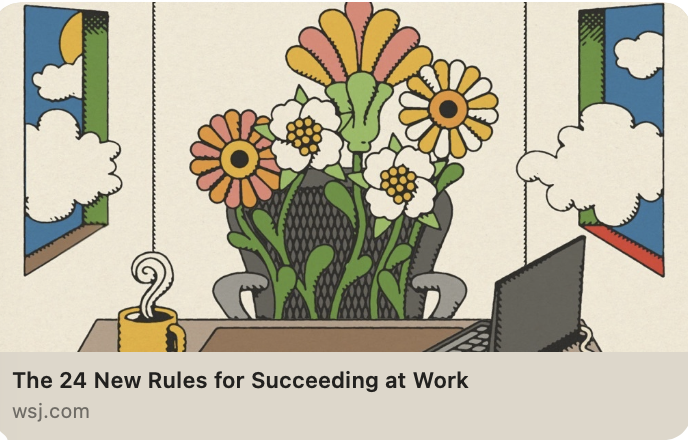
WSJ went straight to the source on this one, asking executives, founders, and career experts for their sharpest, most tactical advice on navigating the modern workplace. No vague "lean in" platitudes. Just specific plays, which is exactly the energy this newsletter runs on.
A few that jumped out at me, all of which back up everything we just covered:
On asking for a raise: Prove your value first, then make the ask collaborative rather than adversarial, and plant the seed months in advance by naming exactly what you'll take on to earn the increase, rather than springing it on your manager cold. Sound familiar? That's the BRAC Book, in one sentence.
On standing out in hybrid meetings: State your name before you speak, and recognize that showing up in person still carries real weight. It's hard to stand out as a face in a grid of squares.
On AI at work: Your edge isn't knowing facts anymore, it's pattern recognition, synthesizing scattered information, and judging what's actually credible. A few contributors were blunt about calling out low-effort "AI slop" work directly instead of letting it slide.
On signaling ambition: Tell your manager where you want to go, but only after you've put in a few solid seasons of proven work. Nobody responds well to a promotion ask in week two.
On getting better feedback: Skip the yes or no questions. Ask what one thing you could do to make it easier to work with you. It gets people to actually answer honestly.
This whole list is the proof: the tactics matter more than the platitudes, and the people already at the top are telling you exactly what they are.
🎙️What I Listened to This Week… (Podcasts)
🎙️Story of the week — YIKES!

Until next week,
You’ve got the Edge. Now sharpen it.
Until next week,

Your Elite Recruiter
Doing the research so you don’t have to.
🚀✨ THE LINKEDIN CHALLENGE ✨🚀
🚨 GIVE ME OCTOBER.
I'm challenging you to 30 days of getting serious about your visibility on LinkedIn. Not to turn you into an influencer, but to make sure the right people know you exist. Recruiters look. Hiring managers look. Boards and investors look. Your next opportunity may never come from clicking Apply. It'll come because someone already knew exactly who you are and what you solve.
This October, I'm running the Elite Recruiter LinkedIn Challenge: 30 days, one action a day, weekly live office hours with me and my team. We'll fix your profile, sharpen your positioning, build your content strategy, and grow the network around your career, on purpose.
Give yourself the gift of transforming how you show up. I'll keep you accountable for the first 30 days. No excuses for failure to launch. If the September Surge catches you flat-footed every year, October is the month that ends it.
Let's break the internet this October. Not with noise. With visibility.
Starts October 1 | $347 | 30 Days
✨ UPCOMING WEBINARS ✨
🚨 THE SEPTEMBER SURGE IS HERE. ARE YOU READY? 🚨
Do you want to enter September ready to move? That’s exactly why I’ve opened my September webinar lineup:
🚀 How to Land a Job in 60 Days
Templates + my Elite Career Positioning System™ for your résumé, LinkedIn, networking, personal brand, and job-search strategy.
💼 The Portfolio Career: The Era of the “Company of 1”
Build consulting, advisory, board, fractional, and speaking opportunities—and create multiple streams of income before you need them.
🎯 The Career Game Plan: Tools & Frameworks for Your Promotion (or Pivot)
Learn the unwritten rules around visibility, influence, positioning, executive presence, and how careers actually move.
Don’t wait for the September Surge to start thinking about your next move. Position yourself now so you can capitalize on it.
🎟️ $99 | 60 Minutes | Live Webinar + Q&A
🔗 Register here: https://www.deepalivyas.com/webinar
✨ ELITE RESOURCES ✨
The Modern Career Stack Includes:
✅ The Signal™ — Your one-page executive snapshot that answers: Who are you, what do you do, and why should anyone care?
✅ Your Executive Résumé — Rebuilt to communicate impact, not responsibilities.
✅ Your LinkedIn Profile — Optimized to attract recruiters, opportunities, and inbound interest.
These three artifacts work together to create a clear, compelling professional narrative.
Whether you're networking, interviewing, speaking at conferences, exploring a portfolio career, or preparing for your next executive move, this is the foundation.
✅ Meet our Elite Coaching Team
Sometimes the challenge isn't your résumé.
It's confidence. It's positioning. It's figuring out what's next.
Our Elite Coaching Team works with professionals from Director to C-Suite on career strategy, executive presence, job search acceleration, leadership challenges, and second-act careers.
The people who win don't necessarily have the best experience. They have the clearest story.
Need a Coach (and a Little Career Therapy)?
🔥 It’s on my ELITE LIST👇🏼
AI agents built to get work done

Skydive agents take on work for you, using the same tools your team already uses.
Talk to your agent on the web, Slack, email, iMessage, or right from your terminal. Wherever you pick up the conversation, your agent keeps the context.
Put agents to work across customer support, sales, marketing, engineering, ops, and more.
Give your agent a job. They’ll take it from there.
🌟 About Me 🤝🏻

🎥 FOLLOW ME
🔥 ELITE RECRUITER ON THE MARCH TO 1 MILLION…AND JOIN ME THIS OCTOBER FOR MY LINKEDIN CHALLENGE 🚀
We’re almost there! If you’ve found this newsletter useful, help me scale it:
Share, forward, comment, or repost. Every action gets us one step closer.

Feedback is a Gift
I would love to know what you thought of this newsletter and any feedback you have for me. Do you have a favorite part? Wish I would add something? Felt confused? Please reply and share your thoughts!